Downtown Boston’s office market continued to stabilize in the second quarter of 2026. Vacancy declined, major leases moved forward at Winthrop Center and demand began to broaden beyond the newest high-rise buildings. At the same time, transit ridership and downtown pedestrian activity strengthened, providing a more positive backdrop for employers, property owners and businesses.
The recovery is still a work in progress. Overall vacancy remains elevated, and performance varies across buildings and office types. But the quarter’s results show several reinforcing signs of improvement within the Downtown Boston Alliance area.
Downtown Boston office market at a glance
Vacancy continued to move in the right direction
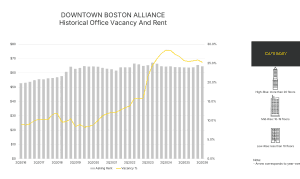
The DBA area’s overall office vacancy rate declined to 25.3% in Q2 2026, down 60 basis points from the prior quarter. Vacancy has now improved by 320 basis points from its historic peak of 28.5% in the second quarter of 2024.
Part of this change reflects a smaller office inventory as buildings move toward residential or other uses. The DBA area contains approximately 16.3 million square feet of office space, representing about two-thirds of its 24.6 million square feet of total commercial inventory. Adaptive reuse projects are expected to continue reducing office availability, particularly among smaller Class B and Class C properties.
The DBA area was the only nearby business district in the report to combine declining inventory, increasing asking rents and decreasing vacancy on a year-over-year basis. That does not mean every building is experiencing the same recovery, but it indicates that the district’s market fundamentals are beginning to stabilize.

Leasing momentum is beginning to broaden
Greater Boston recorded approximately 3.4 million square feet of office leasing during the second quarter, bringing first-half 2026 leasing volume to about 7.3 million square feet. That was the strongest first-half total since 2019.
Within the DBA area, Winthrop Center at 115 Federal Street recorded the two largest leases of the quarter. HNTB Engineering committed to 78,420 square feet, while The Baldwin Group leased another 11,315 square feet. Together, those transactions totaled just under 90,000 square feet.
The quarter also brought an important shift beyond trophy office space. Smaller tenants displaced by office conversion projects are signing leases in comparable nearby buildings. These transactions can help stabilize mid-rise and low-rise properties, where the recovery has generally lagged the strongest high-rise buildings.

Class B office availability is tightening
Recent leasing in Boston’s central business district has often been described as a top-down recovery, with larger tenants competing for premier upper-floor space. Even with elevated overall vacancy, there are relatively few large contiguous blocks available high in the city’s office towers.
A complementary trend is now emerging in Downtown Boston. Availability in the DBA area’s Class B office buildings declined by 300 basis points between the end of 2025 and Q2 2026. Vacancy has not yet fallen by the same amount because a lease removes space from the availability count before a tenant moves in and reduces physical vacancy.
Several of these deals appear to be connected to office conversions. Tenants leaving buildings that will no longer remain in the office inventory are relocating to other nearby properties, creating incremental demand without returning the converted space to the market. The DBA area’s nine residential conversion projects have removed nearly 700,000 square feet of office space.
Transit and foot traffic support Downtown’s recovery
Public transportation remains central to Downtown Boston’s office market. Employers and workers benefit from the district’s concentration of subway and commuter rail connections, and improving ridership provides a stronger foundation for office occupancy and the businesses that depend on downtown activity.
Subway ridership at stations serving the DBA area rebounded after four consecutive months of decline. March ridership increased 28% from February, and April surpassed October 2025 to become the strongest month since fall 2024.
Commuter rail use also rose above 90% of pre-COVID levels. For the first time since the pandemic, the regional commuter rail network recorded three consecutive months with more than 110,000 rides. That is particularly important for the DBA area because many workers reach nearby office buildings through South Station.
Pedestrian volumes recovered from a late-winter dip as well. Downtown recorded nearly 3 million visits in June, when major events including the FIFA World Cup, Sail Boston and the United States’ 250th anniversary brought visible activity to the district.

What the Q2 results mean for Downtown Boston
Downtown Boston’s office market has not fully recovered, but the second quarter provides evidence that improvement is becoming broader and more durable. Newer high-rise buildings continue to lead leasing activity, Class B availability is tightening, office conversions are reshaping the supply of space and transit and pedestrian activity are strengthening.
Together, these trends support a more active, mixed-use Downtown. As tenants occupy newly leased space and underused buildings move toward new uses, the district gains more workers, residents and visitors who can support retailers, restaurants and other downtown businesses throughout the week.